Published course
Project Guides
CVA6: Capabilities, Systems and Evidence
Read real configurations, explain execution, and evaluate software, maturity and application evidence.
CVA6 project and further resourcesOpenHW Explorer
Introducing CVA6: Architecture, Uses and Engineering Evidence
A community course by Alex Chen · Based on public technical sources · Narration: 21 min; activities are additional
Listen to this scene
Download captionsIf you want a RISC-V processor design that you can study,
Pause, seek or change playback speed. Captions are displayed in short phrases.
Check your CVA6 understanding with four decisions
Read the explanations after submission; consult sources and retry.
Answer all four questions before submitting.
Scene transcript
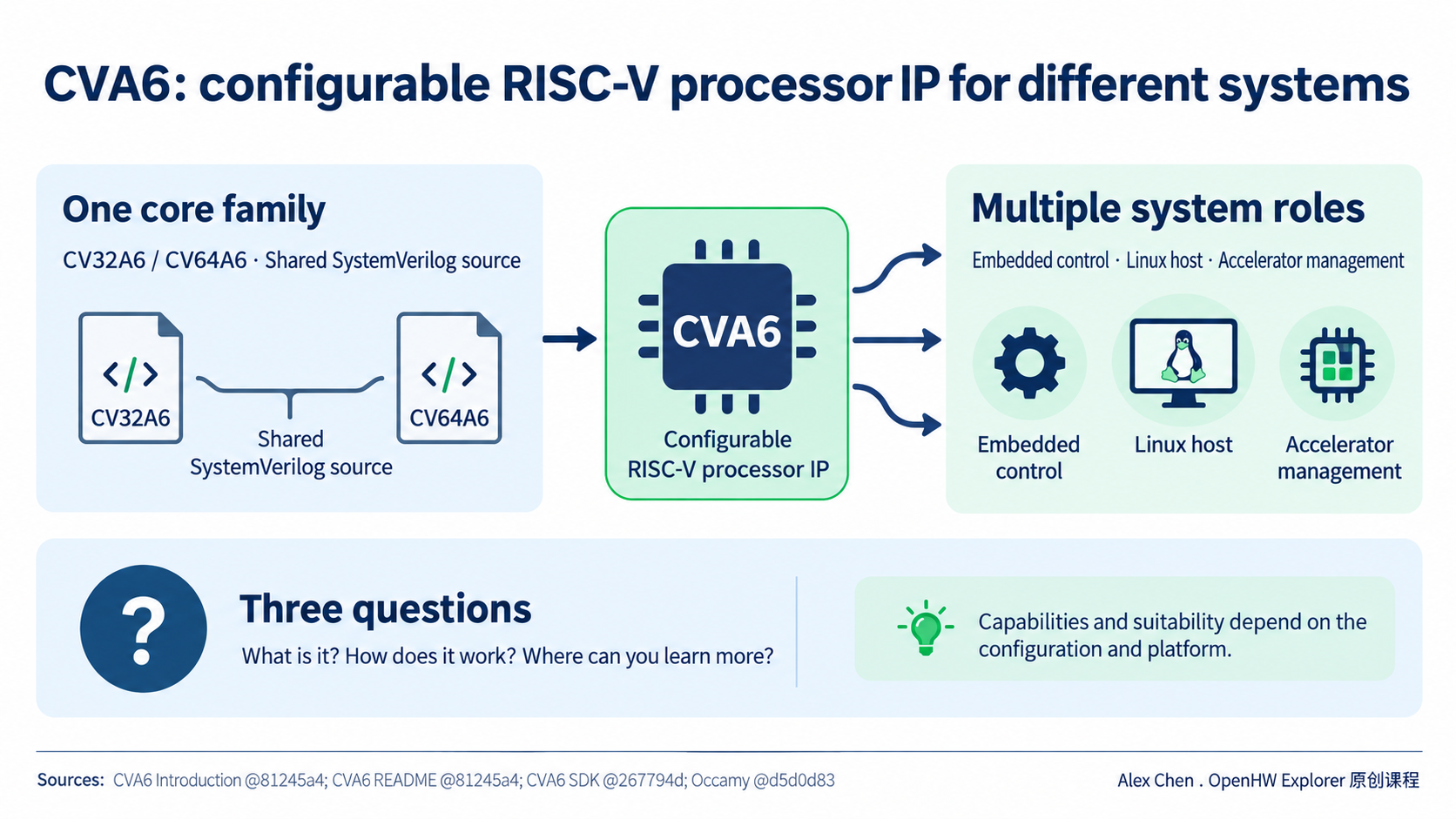
If you want a RISC-V processor design that you can study, modify and integrate into a system, CVA6 offers a concrete starting point. It is a configurable open-source processor-IP family, with 32-bit and 64-bit variants sharing SystemVerilog source. IP means a reusable hardware design: the core executes instructions, while memory, peripherals and software complete the system. We will see embedded control, Linux hosting and accelerator management. Those uses are possibilities supported by specific configurations and platforms. They are not guarantees for every variant. This overview answers three questions: what is CVA6, how does it process instructions, and where can you learn more? By the end, you should be able to distinguish a core from a system, read a configuration example, and identify the evidence needed for a capability claim. I created this community course for OpenHW Explorer, interpreting official documentation and project records. Detailed architecture and verification topics are left for later lessons.
What to understand
What is CVA6, and why learn about it?
One core family
CV32A6 / CV64A6 · Shared SystemVerilog source
Multiple system roles
Embedded control · Linux host · Accelerator management
Three questions
What is it? How does it work? Where can you learn more?
Capabilities and suitability depend on the configuration and platform.
Separate a processor design from a complete board-level system; reconnect them later through an SDK platform.
Technical sources and locators
CVA6 Introduction
CVA6 Overview; Configurations
C01: configurable shared RV32/RV64 RTL
Published user manual
CVA6 Overview; Configurations
C01: configurable shared RV32/RV64 RTL
CVA6 README
Directory Structure
C03: core vs system integration boundary
CVA6 SDK
CVA6 compatibility
Linux target example
Occamy README
README opening
Accelerator-management role
A community course authored by Alex Chen, interpreting official materials. Each page preserves source versions and configuration scope.
Found outdated or incorrect information? Report it on GitHub